1. Introduction
The demand for highly relevant content—across channels like email, landing pages, SMS, and LinkedIn—continues to grow. Marketers and communicators strive to deliver tailored messages that maximize performance (e.g., conversions, engagement) for each recipient. Over the years, various architectures have evolved to address this need.
While recent research on the topic attempts to name the different approaches - we believe this naming convention encompasses the approach with a high degree of accuracy.
- Traditional Approach: Human-curated segmentation and manual content creation.
- Single-Pass LLM Approach: Rely on a single large language model prompt to generate content.
- Complex LLM Workflow: Structure the generation process into multiple steps (e.g., Research → Generate → Verify).
While each has strengths, several significant limitations remain—particularly around scalability, complexity, compliance, and ensuring that nuanced logic is handled accurately. This whitepaper reviews existing architectures and introduces Modular Communication Strategy Architecture (MCSA) as a superior solution focused on performance and reliability in generating relevant content at scale.
2. Problem Statement
Despite improvements introduced by more advanced LLM workflows, key challenges persist and
- Stochastic Content Generation: Outputs from LLMs are unpredictable; this complicates static validation, especially if compliance or brand consistency is crucial.
- Complex Logic Gaps: Certain segmentation or personalization tasks (e.g., percentile-based segmentation or advanced branching) remain difficult for even reasoning-oriented LLMs, often leading to incorrect or “hallucinated” outputs.
- Prompt Engineering Complexity: Long or intricate prompts can be unwieldy, making them inaccessible to non-experts and prone to errors.
- Static Content Cost: Generating large volumes of content, particularly if each variant is separately triggered, can lead to high compute costs.
- Limited Learning Integration: Traditional LLM approaches struggle to incorporate post-send learnings (e.g., from recommendation engines or A/B testing), hindering iterative improvement.
These issues hinder organizations’ ability to efficiently produce high-performing content at scale.
3. Introduction to MSCA
The Modular Communication Strategy Architecture (MCSA) aims to resolve these issues by integrating a composable design, robust automation, and the capacity to incorporate advanced logic and iterative learning. The architecture is built around Modular Communication Tactics (MCTs)—reusable building blocks for complex messaging strategies.
MCSA’s design prioritizes:
- Performance: By orchestrating multiple AI components and procedural logic, messages can be carefully tailored for each recipient’s context.
- Adaptability: MCTs let users flexibly combine personalization elements, logic-driven branching, and iterative tests (e.g., A/B or multi-armed bandits).
- Scalability: The entire framework is designed to handle large audience sizes.
In the following sections, we briefly survey how earlier approaches evolved and how MCSA both learns from and surpasses them.
4. Architecture Descriptions
Below is a high-level overview of the three pre-existing architectures. Each successive approach attempts to address shortcomings in the prior ones, yet still faces certain constraints that MCSA overcomes.
4.1 Traditional Approach
Overview
- Marketers or copywriters segment audiences based on known criteria (e.g., demographics, purchase history).
- Each segment receives a manually written copy with personalization tokens.
- Changes or updates often require rewriting and re-segmenting.

Advanced Techniques
Advanced techniques from the traditional architecture include:
- A/B testing - mostly used on subject lines - some platforms allow for A/B testing of specific content sending a percentage of the content to a small portion of the list, and then adjusting the content for the full list.
- Recommendation engines - especially on the B2C side - communication tools linked to e-commerce platform support product recommendation as one of the most advanced techniques
How It Addresses Previous Gaps
- N/A (this is the baseline, oldest method).
Ongoing Challenges
- Labor-intensive and difficult to scale.
- Lacks the ability to dynamically learn from user responses without significant human intervention.
- High potential for inconsistent or error-prone segmentation logic when done manually.
Examples
- Hubspot, Marketo, Eloqua, Mailchimp, Braze, etc.

Advanced Techniques
Advanced techniques from the traditional architecture include:
- A/B testing - mostly used on subject lines - some platforms allow for A/B testing of specific content sending a percentage of the content to a small portion of the list, and then adjusting the content for the full list.
- Recommendation engines - especially on the B2C side - communication tools linked to e-commerce platform support product recommendation as one of the most advanced techniques
How It Addresses Previous Gaps
- N/A (this is the baseline, oldest method).
Ongoing Challenges
- Labor-intensive and difficult to scale.
- Lacks the ability to dynamically learn from user responses without significant human intervention.
- High potential for inconsistent or error-prone segmentation logic when done manually.
Examples
- Hubspot, Marketo, Eloqua, Mailchimp, Braze, etc.
4.2 Single-Pass LLM Approach
Overview

Advanced Techniques
Advanced techniques from the traditional architecture include:
- A/B testing - mostly used on subject lines - some platforms allow for A/B testing of specific content sending a percentage of the content to a small portion of the list, and then adjusting the content for the full list.
- Recommendation engines - especially on the B2C side - communication tools linked to e-commerce platform support product recommendation as one of the most advanced techniques
How It Addresses Previous Gaps
- N/A (this is the baseline, oldest method).
Ongoing Challenges
- Labor-intensive and difficult to scale.
- Lacks the ability to dynamically learn from user responses without significant human intervention.
- High potential for inconsistent or error-prone segmentation logic when done manually.
Examples
- Hubspot, Marketo, Eloqua, Mailchimp, Braze, etc.
4.2 Single-Pass LLM Approach
Overview
- A single large language model prompt uses available user data and instructions to generate each piece of content.
- The entire output is generated in “one shot,” with minimal intermediate checks.
How It Fixes Traditional Issues
- Reduces human labor—marketers can quickly generate multiple variants.
- Potentially more personalized content if the prompt is well-engineered.
Remaining Gaps
- High unpredictability in the final output.
- Limited or no iterative logic for complex segmentation.
- No ability to leverage external data.
- Potentially high compute costs if each recipient requires a unique generation.
- Research shows that while LLMs can serve as recommendation engines and provide great results before there’s data - they can underperform traditional recommendation engines when textual information is not sufficient.
Examples
While some new start ups are emerging with this approach - most new startups are adopting the Complex LLM Workflow.
4.3 Complex LLM Workflow
Overview
- Breaks the generation pipeline into three or more stages (e.g., Research → Generate → Verify).
- Allows for data-gathering and some validation before final content is produced.
- Improves output quality over single-pass methods.
It incorporated advancements such as Guided Profile Generation (GPG) that improves performance by doing general summaries of research content.
How It Improves on Single-Pass
- More robust data integration.
- Some check-and-balance mechanism to reduce blatant errors or inconsistencies.
Remaining Gaps
- Still relies heavily on LLM responses for nuanced logic, which can cause hallucinations.
- Complex to set up and maintain.
- This solution exhibits inferior performance at recommendations than a traditional recommendation engine.
- Difficult to incorporate real-time or iterative learning from user behavior (e.g., A/B results, recommendations).
Examples In Practice
It is worth noting that in practice, no industry solution as of the writing of this whitepaper incorporates the Review phase - resulting in overall worse results than what described in this paper.
Companies such as
To name a few all follow a similar approach to the one described.
5. Approach
Writing thesis:
Existing research shows that while reasoning models (inference time compute models) are improving in coding and math domains - these improvements are not mirrored in the domain of personal writing.

We expect this trend to continue as easily benchmarkable problems (such as accuracy in coding) are optimized for before hard / expensive to benchmark solutions which require human feedback.
Our conclusion was that a mix model focusing on coding and data application while allowing human assisted writing would perform better than a “blackbox” model that attempted to write the entire content dynamically.
Architecture thesis:
Research such as the ComplexityNet paper that demonstrates performance of models degrades for more complex tasks.
To combat this we took ideas from several research papers demonstrating the advantage of a modular architecture in reliability for example.
One key mode of a modular architecture is the Mixture of Experts architecture. We took this idea to the extreme for this approach coming up with a set of data-proven Communication Tactics as our experts.
Recommendation problem:
We’ve looked into research for recommendation, having settled on a modular approach we had the opportunity of optimizing for the best architecture.
Given this we introduced a hybrid recommendation engine using LLMs to solve the cold-start problem - which has been shown to perform better than either standalone solution allows.
Practical considerations:
One key disadvantage of the Complex LLM Workflows is that they require a complex fine-tune prompt to “get right.”
While in theory an expert can craft a very complex nuanced prompt - in practice even getting to the correct complex prompt is itself an arduous task as demonstrated by early usability tests.
Our goals were not just about performance, but also about usability and UI.In this approach we envisioned a modular architecture represented visually in a way that is familiar to copywriters allowing non technical individuals to fully utilize the platform.
6. Full Introduction to MCSA
MCSA is a next-generation framework that addresses the shortcomings of the Complex LLM Workflow and earlier approaches by merging structured logic, advanced AI capabilities, and modular design. It is composed of:
- Modular Communication Tactics (MCTs)
- Definition: Reusable blocks of messaging logic—such as branching, dynamic token insertion, personalized recommendations, multi-armed bandit test setups—that can be assembled like building blocks.
- Benefit: Non-expert marketers can leverage MCTs without deep prompt-engineering knowledge.
- Multi-Phase Pipeline
- Composing phase: This is where the user is interacting with the user interface and composing the template. In the complex LLM Workflow
- Dynamic Research & Cleanup: Gathers new data from APIs, logs, or analytics platforms, automatically cleansing and structuring it for downstream use.
- Precomputing: Executes transformations or computations (e.g., segment assignments, product filtering) once, minimizing repeated compute.
- Dynamic Generation: Produces the final text (or images) by combining AI generation with straightforward procedural logic. This stage can incorporate or bypass LLMs where beneficial.
- Post-Processing & Reviewing: Applies final corrections or style guidelines, with optional human checks when needed.
- Feedback and Iteration
- Because MCSA is modular, it can integrate real-time feedback loops. For instance, a recommendation MCT can learn from recipients’ engagement and refine suggestions.

Why It Delivers Superior Performance
- Controlled Stochasticity: LLM steps are constrained by modular logic, reducing random or out-of-scope generations.
- Efficient Compute: Repeated tasks—like data cleanup or segment classification—are done once (precompute), reducing cost.
- Scalable Personalization: MCTs allow a single base “template” to adapt to hundreds or thousands of recipients without re-engineering the entire prompt logic.
7. Comparison
7.1 A single paragraph
We will be going over a representative example comparing MCSA to a Complex LLM Workflow.
Our goal (in prompt form):
I want to segment by vertical, to prospect customers (marketers) select the best offering and create a personalized example of how they would use the product.
To investors tell why the underlying technology is superior.
We will be building up the case of an email going out promoting an example product.
We will start with a simple paragraph, and build up the complexity from there.
At the end we will demonstrate some example full emails generated on each approach - and the required “Generation” prompt (for the complex LLM Workflow) - or template builder (for MCSA on Singulate)

To start things this process is simple and does not incur in high costs - however the missed opportunity of doing pre-generation work is paid back in a very expensive and less relevant Generation phase:
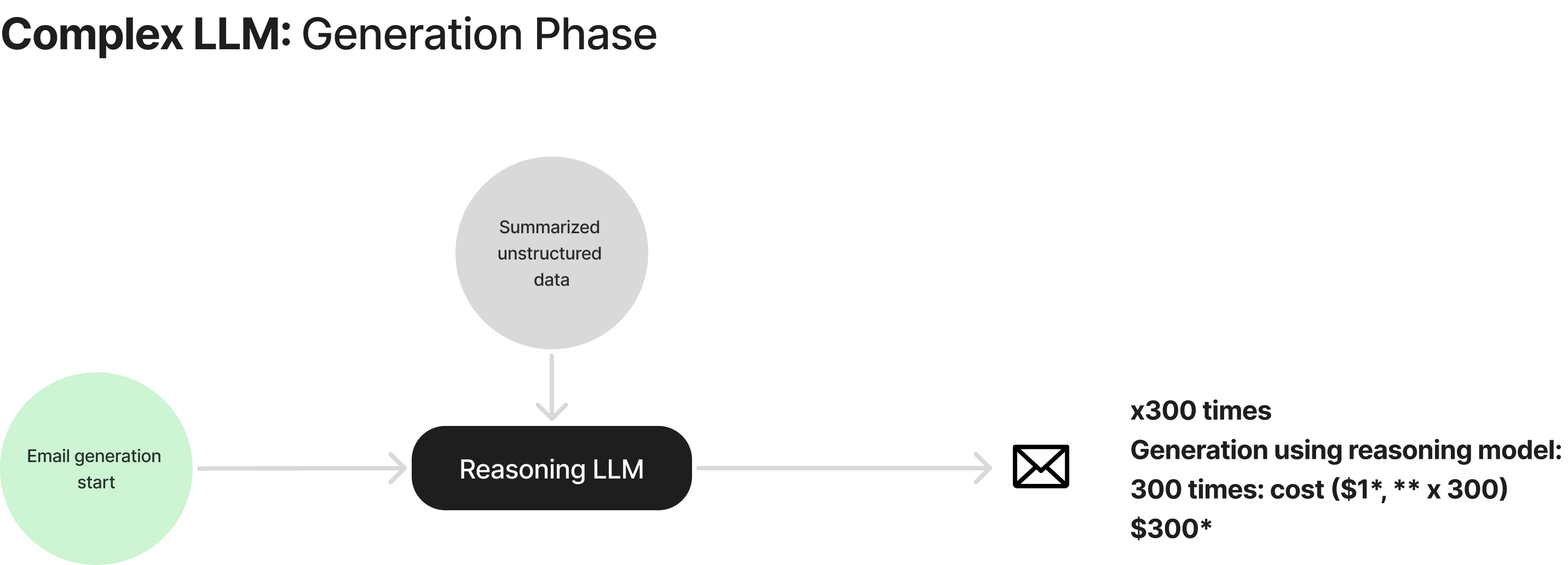
Finally the Review phase which would be the same in both processes (although we should clarify again that this step is not yet performed by any known product as of the writing of this whitepaper).

Giving a total cost of: $312*, ** for 300 highly stochastic low quality email - on a single paragraph - or Or $1.04 per email
*Using representative figures for cost of reasoning, research, agents, and generation
** In practice for the Complex LLM approach you may want to compound more than one Reasoning LLM prompt to compensate for very poor performance, scaling up Generation-phase compute requirements.
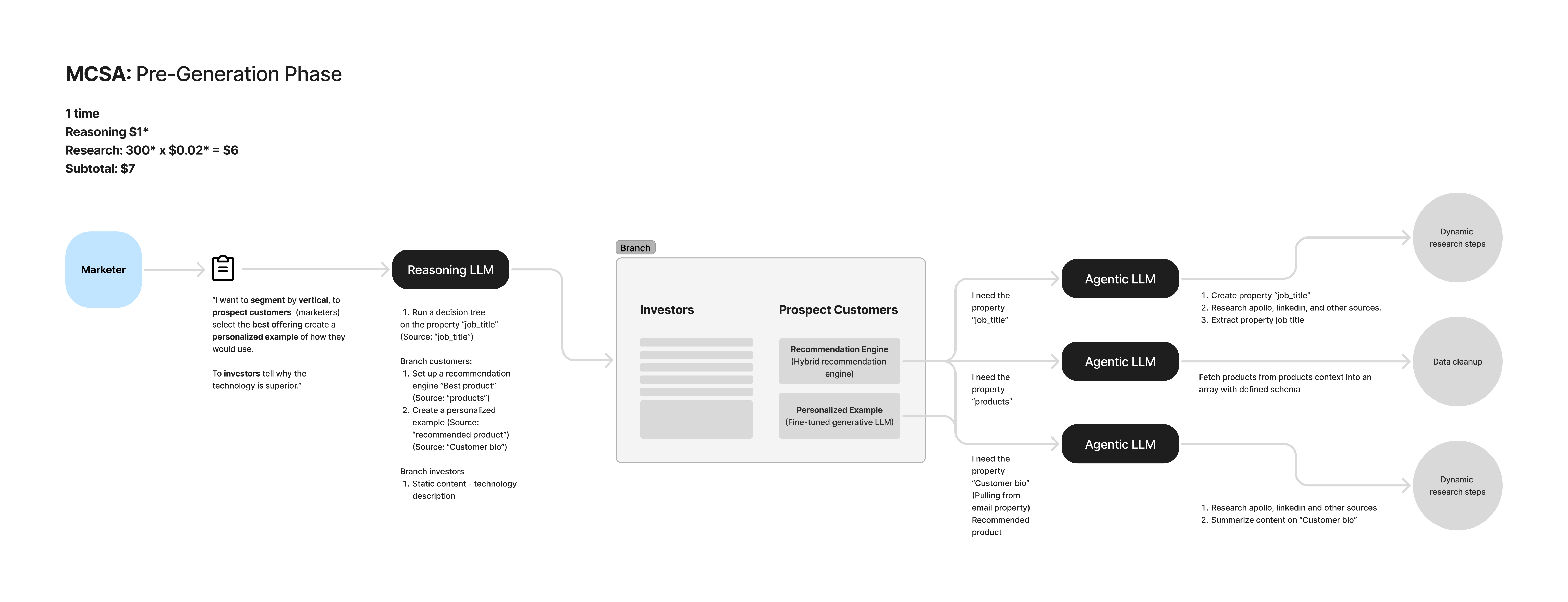
MCSA will start creating the Modular Communication Tactics (MCTs) and spend reasoning time up-front.

The result is a much more focused, relevant, and performant generation phase.
Finally Singulate is the first-to-market to introduce the Review Phase in practice.
Bringing down drastically the per-email costs by 20x*
Total cost: $16* - or $1 + 5c per email
*Using representative figures for cost of reasoning, research, agents, and generation
7.2 An example full email - representative example
Complex LLM Approach (1st pass)
We are trying to find sponsors for our customer - Saastock.
We will begin with a simple prompt utilizing the Complex LLM approach
The data has been already enriched and pre-structured, so we are going to focus on the generation approach (Note we’ve anonymized and redacted the contact data to present here):

It starts becoming clear several problems with the LLM trying to resolve this with a condensed prompt.
First, it’s struggling to create a structure / layout for the email that’s accurate (and it was already hard from a practical standpoint to craft this prompt vs using a UI).
Second, the LLM is creating a very verbose personalization over 240 words to communicate little information.
Some bad examples flagged by expert copywriters include:
I hope you're doing well. I'm reaching out because I've been impressed by your achievements at Cohesity - especially your success with the TO fundraiser, which recently boosted its annual sponsorship to $2M. Your expertise in marketing events and sponsorship makes you a perfect fit for a unique opportunity at SaaStock.
Why it's bad: it is just reading back info to the contact:
Sponsoring SaaStock offers significant benefits, including:
High-Value Connections: Every attendee is a potential customer or strategic contact.
Innovation Engagement: Our Al-powered networking app drives meaningful interactions.
Proven ROl: 93% of our sponsors (typically at $5-$10M annual revenue) report positive returns, with sponsorship being a major growth driver.
Exposure for All: Even emerging companies gain valuable exposure.
Why it's bad: Fails to be relevant to the contact - who has a company just in the 93% range and is NOT an emerging company (so fails to establish a connection).
To name some examples where the system is not following copywriter’s best practices.
Complex LLM Approach (2nd pass)
For the second pass we started by creating a MCSA (see MCSA approach below) to give the Complex LLM approach the best chance - once we built the perfect email with MCSA, we attempted to work backwards and tailor the prompt to match the exact same intent we had with the newer approach
Attempting a second pass using a Complex LLM approach and a much more complex prompt:

A much more complex prompt required a reasoning time over 1minute 11 seconds - highly escalating the costs.
While it managed to stay concise, it still suffered from several copywriting issues and failed opportunities - on top it starts introducing hallucinations that risk damaging the experience.
Some highlighted issues include:
- It missed the opportunity (even though instructed to follow it directly) of noting that Cohesity is within the 10M range that fits the proof point of sponsors entirely.
- It failed to bring up the fact that there were 13 remaining slots (adding extra capacity made it forget some basic aspects of the prompt)
- Still some of the copywriting approach was pretty basic
While it’s hard to demonstrate from a single example - this example illustrates the overall very variable quality of outputs of the Complex LLM approach - as well as its increased risk of customer relationship damaging hallucinations.
MCSA (1st pass)
As noted above, the prompt for the Complex LLM Approach 2nd pass was based on the MCSA solution, given the customer was failing to get the right prompt without a graphical UI - this is why some of the paragraphs on this approach are going to match Complex LLM Approach 2nd pass.
Overall - our customer interacted mainly through our user interface - here is the result:

Worth highlighting some critical passages:
93% of our sponsors at Cohesity's size ($5-$10m annual revenue) say that sponsoring SaaStock had a positive Ol for their business and was one of the most significant growth drivers for their business last year.
It is a critical part of the communication and manages to convey a lot of information concisely by introducing a proof point and relating it back to the instructions.
I'm pumped to see you there!
Is a simple - but important outro maintaining the tone of voice of the communication.
Overall this communication was able to be produced by the cheapest available models on the generative side - as well as using binary trees for the classification making the overall send under 2c an email.
The overall performance was over 4x their pre-existing solution, a result that has not been matched by a Complex LLM approach yet.
8. Conclusion
As organizations strive to deliver high-performing content across varied channels and formats, they face persistent challenges around personalization, scalability, and reliability. Traditional and LLM-based workflows have solved some problems but introduced new ones—particularly around managing stochastic outputs, complex logic, and iterative learning.
MCSA emerges as a robust, modular architecture that balances AI-driven generation with logical structure and adaptable tactics. Early indications show it consistently outperforms older methods in terms of both performance (e.g., engagement metrics) and compute efficiency. By integrating Modular Communication Tactics (MCTs) and a multi-phase pipeline, MCSA optimizes each step of the content creation process, bringing together the best of AI capabilities with the clarity of rule-based logic.


