AI Strategies for Personalization with the Data You Already Have
Escape the Mail Merge Mindset. Use your existing data (e.g., industry, job title) to create more relevant messaging at scale. Say no to AI slop. Say hello to Adaptive Content.
.jpg)

This is the written content of my presentation from my session at Mopza-palooza in October 2025 in Anaheim. No, I didn't just plug it into ChatGPT to re-purpose it into a blog post.
Q: What do these 2 images have in common?
.png)
A: They were both invented in the 1980s.
Why Are We Still Personalizing Like It’s the 1980s?
Think about it.
The mail merge feature was first introduced in 1983 with WordStar and WordPerfect, and shortly after became mainstream when Microsoft Word 3.0 (1986) added “Mail Merge” for printing personalized form letters.
Today, 45 years later, we use CRM tokens like {{Industry}} to personalize our communications in the same way merge tags were used in the 1980s.
We’re still relying on the same primitive tools to “personalize” our emails, ads, and content.
It’s like using a Walkman in the age of Spotify. Do you still carry CDs around still to listen to music? No. So why should B2B marketers still use static tokens to personalize their content?
This is why:
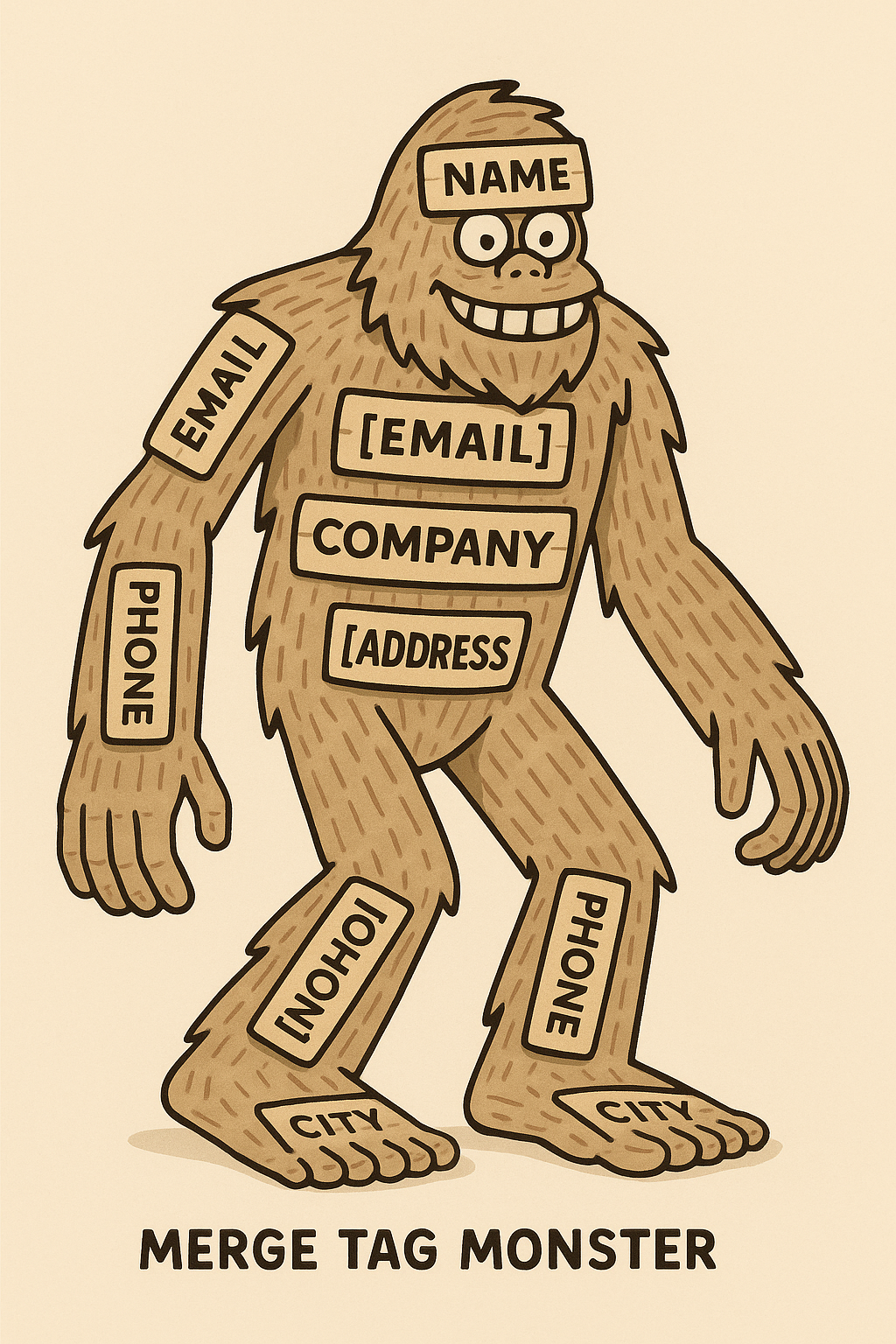
Its cave sits right in between content and data, scaring them away from becoming one integrated system.
Before we go on.
You’re probably wondering.
Is the Merge Tag Monster even a problem worth fixing?
Why does this matter?
Zoom out and look at every B2B company’s journey.
All B2B companies are on a journey towards personalization on all channels.

Every company is on the same path toward true personalization.
- Companies up to $20M ARR: Usually a $500k marketing budget, working with their basic and internal data and starting to experiment with in data enrichment
- $100M ARR: Marketing budgets and headcount grow - $5M+ marketing team layering in automated enrichment and cleaning their data. Experimenting with segmentation.
- $1B ARR: Multiple-million dollar marketing budgets with entire teams and tech stacks dedicated to 1:1 personalization at scale.
Look at the end of the journey: 1:1 personalization at scale is the holy grail of B2B marketing. But it’s extremely resource-intensive and difficult to do.
But anything less than 1:1 personalization at scale is leaving growth on the table.
You’ve read the articles.
- McKinsey found companies that excel at personalization “drive 40% more of their revenue from personalization” than slower-growing peers.
- In Forrester’s Total Economic Impact study, moving to personalized, automated conversations increased click-to-conversion from 3.3% to 12.2% (a 267% lift).
- Gartner says the future is 1:1, not coarse segments. Gartner’s guidance points to “one large segment that can offer 1:1 personalization,” and its Account-Based Everything framework centers on coordinated, highly personalized engagement across marketing, sales, and success.
- Jay Schwedelson’s testing across billions of emails shows “first-name” tokens alone don’t move the needle; relevance at the company/role/interest level does, lifting opens by ~30% (seasonally observed).
- 89% of leaders say personalization is crucial to success over the next three years; leading marketing orgs report they’re investing to deliver personalization at scale.
We ran a study of our own.

Here “singulated” is our shorthand word for “researched, segmented, and personalized” - it means the content is unique and relevant to the individual.
Singulated messaging increased performance by 390% by generating an average click through rate of 7% compared to 1.28%.
At Singulate, this approach helps us consistently book 20+ demos per week with one SDR. Look at my calendar.
.png)
Let’s unpack this new future of personalization with 4 shifts in strategy for using data, AI, and messaging at scale.
4 Ways to Escape the Mail Merge Mindset
1. Bring Your Data and Content Closer Together
True personalization happens when content and data teams collaborate.When messaging is built with the data, not after it, it becomes naturally relevant — tailored to how real people see themselves.

2. Use “The Shoe Test”
Before you hit send, put yourself in your contact’s shoes. Ask 3 questions:
- Is this message actually relevant to them?
- Does it make them feel seen and understood?
- If I were writing this 1:1, what would I change?

If the answer isn’t clear, the message isn’t personalized enough.
3. Pass the “Invisibility Test”
If you can simply “Find and Replace” your merge tags and the message still works, it’s not personalization — it’s static content.

True personalization is invisible. It doesn’t look personalized. It's just written just for you.
4. Shift from the Mail Merge Mindset to Adaptive Content (Example)
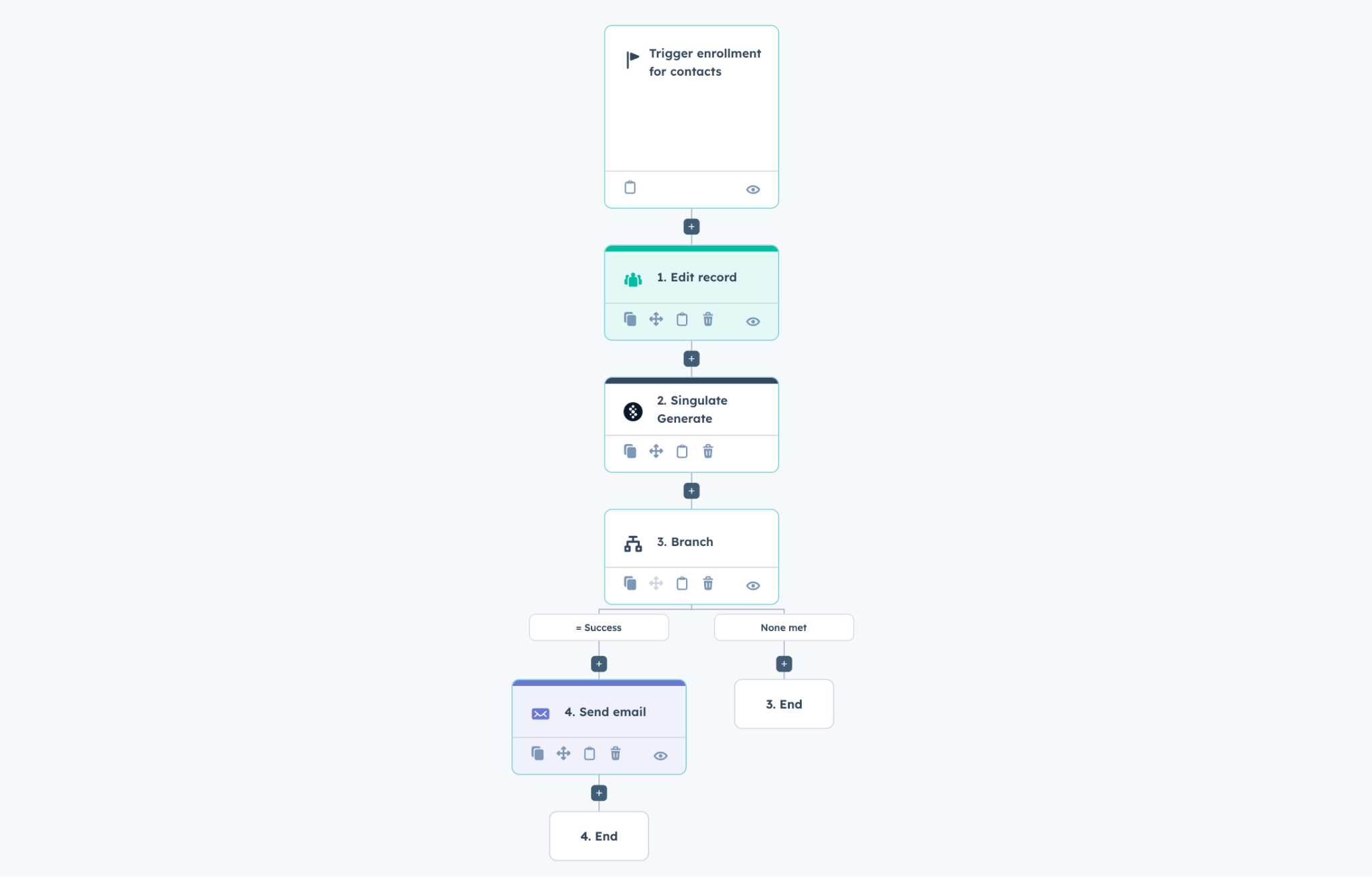
Let’s break this down.
- In Step 2, the Singulate Generate step prompts HubSpot to ask Singulate what content should the enrollee receive.
- Singulate replies to HubSpot (via API), “Send this contact this content” according to the messaging strategy of the Singulate template built by the marketer.
What’s happening under the hood: Singulate (AI personalization platform) contains a “template” with modules of content that have deeply segmented messaging, 1:1 personalized content, and real-time researched data that has been transformed into relevant and fine-tuned copywriting.
(The branch in the workflow is for reliability.)
- The final step is a HubSpot email that is unique and relevant to the contact, that passes all of the personalization tests above. This email exists in HubSpot so the data and reporting stay within your CRM, your source of truth.
(Personal Rant) Bonus: Kill the Spintax
This might be just a personal rant of mine but spintax is awful.

Spintax isn’t personalization — it’s randomization.
It’s randomly swapping out text phrases so that the blast message is mixed up. It’s a deliverability tactic. There’s zero value to the end user. There’s no additional relevance it provides because it’s not based on any contact or company data.
The better solution is to use data and change messaging up so that it’s actually adding thoughtful relevance to the contact. Tools like Singulate make this just as easy to do with AI as using spintax.
7 Hyper-Specific Ways to Use AI to Personalize with Common Data Fields
1. Industry
Don’t just drop in the {{Industry}} token and call it a day. Then you’ll get something that looks like this:
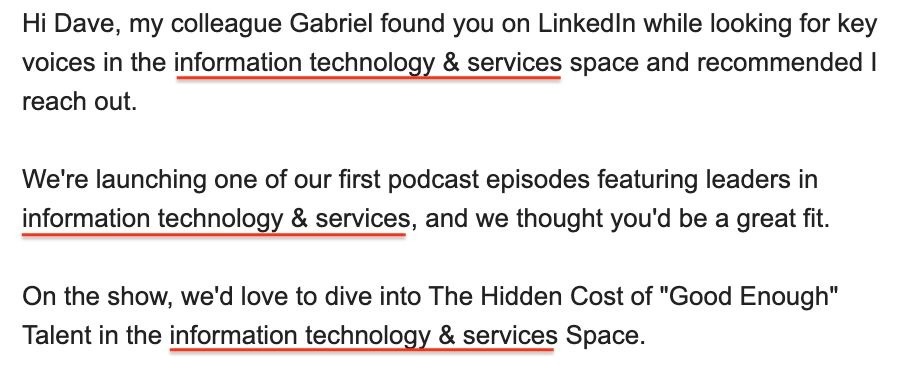
Do this instead: Write in the natural language of that industry. How would you actually talk about your industry? If you work in tech, you probably say you work in “tech” not “information technology & services.” The token itself isn’t enough. It needs to be adapted.
Takeaway: Use AI to transform data fields into more conversational writing. P.S. This is exactly how a Wow Tag works in Singulate. You drop a token in and then use a prompt to reformat the token to work at scale for every person.
2. Job Title
Ever read a sentence that starts with “As a {{Job Title}} at {{Company}},” ?
You can bet your bottom dollar, the rest of the sentence is the same for everyone.
It doesn’t matter if your job title is in marketing or in sales or in engineering.
The core statement doesn’t change. Just the framing of it..
This is not personalization. This is the Merge Tag Monster in full strength.
What's happening: It’s static tokens used to make it seem like the content is relevant but it doesn’t actually provide any additional value to the recipient.
Why are you telling someone what their job title is? Don’t you think they know what their job title? If you, just you, were writing this directly to the person, one-to-one, would you write “As a Director of Marketing,”
Instead, focus on changing the core message AFTER the comma.
The best way to do this is to micro-segment that block and adapt the core messaging to the persona. This is what Branched Content does in Singulate.
3. Company Name
Don’t: Use the full legal name (e.g., “Benefis Health System”).
Do: Normalize it to how a human would say it - “Benefis.”
You want to write the company name in the same way the contact uses it in conversations.
For example, if the company name is The Steagall Brothers International, LLC, you wouldn’t say that if you were talking about the company.
You’d say “Steagall Brothers” or just Steagall.
This level of intelligent normalization is easy to do with AI with a prompt like this:

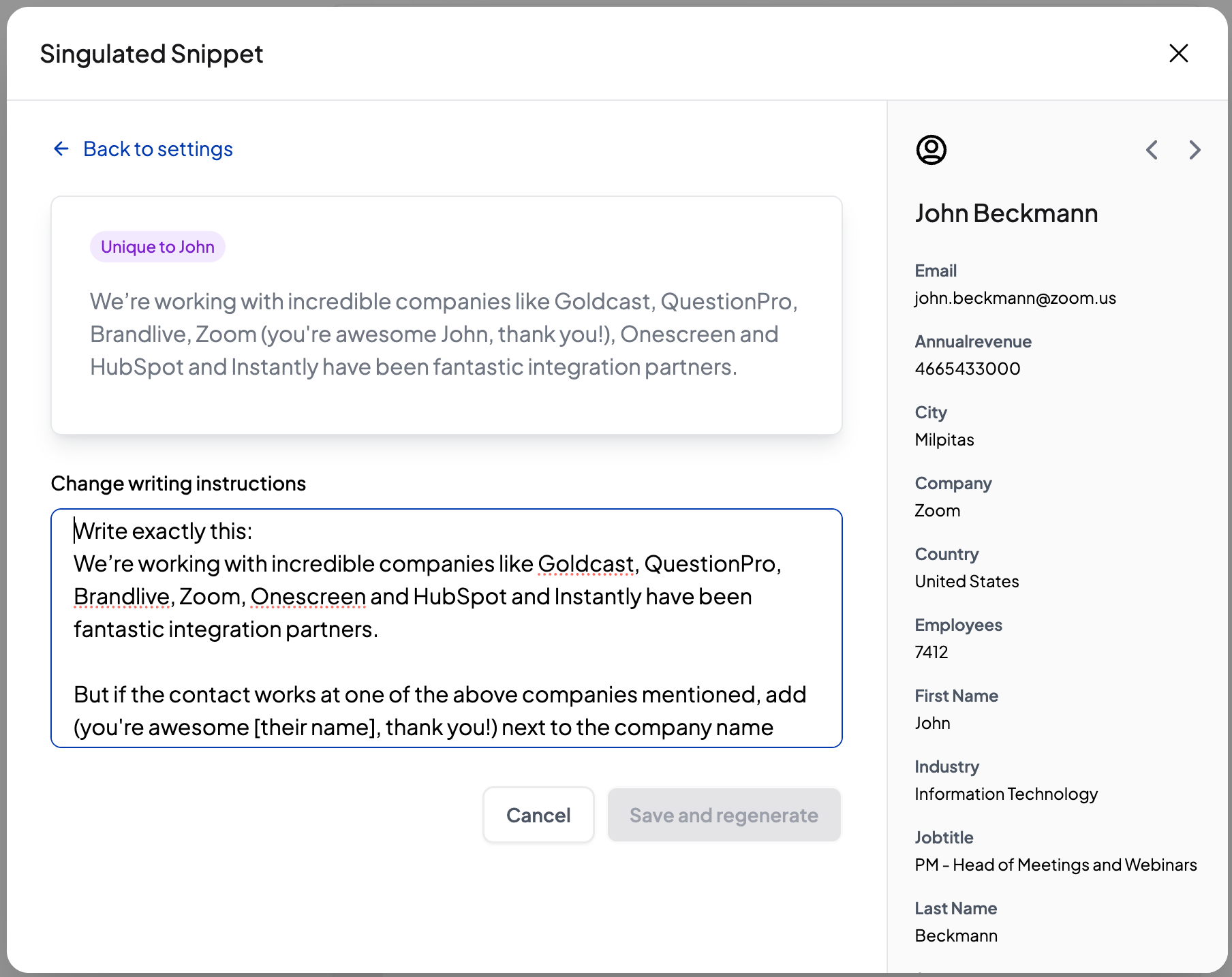
4. Lifecycle Stage
Don’t: Treat every contact like they’re in the same funnel stage.
Do: Acknowledge where they are — awareness, consideration, or customer — and tailor your tone and messaging.
Example:
5. Web Research
Don’t: “I saw on your LinkedIn that you like the Bears!”
Do: Comment on a relevant blog, news, competitor, or customers. Be relevant, not observant.

6. Seniority
Don’t: Send the same CTA to a manager and a CMO.
Do: Segment your CTAs to match the influence they bring to your sales process or NRR.
Example: gift card

7. Skip Logic
Don’t: Send generic fallback messages.
Do: Use skip logic — only send personalized content when you have data. Everyone else gets a short, human alternative.
Example:

The Big Takeaway
Merge tags are almost half a century old.
It’s time to move B2B marketing from Mail Merge Mindset to Adaptive Content.
AI-native tools today like Singulate introduce new ways to leverage contact and company data in marketing messaging across the funnel.
I’m very excited to be part of this movement.
What used to take millions of dollars and huge teams, tools, and processes, is now possible for one hybrid Marketer to do themselves.
We’re only at the beginning.
What a time to be alive as a B2B marketer.
Connect with me on LinkedIn if you want to follow along, try our sandbox or book a demo to see adaptive personalization in action.