
.png)
I’m Nico. I’m one of the co-founders of Singulate.
My specialty is at the intersection of product and engineering. A little bit about my background: I moved to London in 2013. I did a master’s in finance, and then started working at tech companies, mostly on the engineering side of things at the beginning. Over my last couple of roles, I ended up leading engineering teams before there was a product manager, and naturally fit into this dual product–engineering leadership role.
My two bigger gigs first include Hopin. I joined Hopin back when there were three or four people working there. I joined to lead the engineering team and eventually became Director of Engineering. I helped the company scale from zero to about forty engineers, going through the very early, standard hypergrowth cycle.
While I was there, I managed parts of the M&A processes. My last role at Hopin was managing the launch of a new product called Superwave. Unfortunately, the timing wasn’t great — it launched while everything else was kind of problematic for the business. But the problem we were trying to solve was a pretty solid one.
In 2023, with the boom of AI, I had already been feeling for a while that Hopin as an operator had become a bit stagnant. I wanted to do something more exciting — honestly, something refreshing. I met a few people in London and eventually met Hassan from 11x.
I loved his story and where they were at. They were a team of four people, which really resonated with me and reminded me of the early days at Hopin. It felt like a really exciting opportunity. I also really liked what they were doing with LLMs at the time. A lot of people were still trying to figure out what LLMs would actually be used for.
I really liked the B2B approach, I liked the cost-savings angle, and once I started digging into it, they had this AI SDR product that seemed to be really working — people wanted it, and sales were happening. I felt like this was a really solid opportunity, so I jumped in.
It was an interesting time because they had cracked what people wanted, and customers were buying a pretty rough prototype of Alice very quickly, with a very low customer acquisition cost. But they were churning at almost the same rate. A lot of my work there was about convincing leadership to let go of the original idea — which was essentially a marketplace of AI agents — and instead narrow down.
That broader idea was a good long-term vision, but we were a pre-Series A company and needed to focus on one product that was actually selling.
There were a few key insights around AI SDRs specifically. One really important insight was that people weren’t churning because they didn’t want the product. There were many reasons for churn — some inherited complexities with cold outreach — but the biggest reason was basic functionality: the login page wasn’t working, the Gmail integration wasn’t working, emails weren’t sending.
These were solvable problems. I knew that if we focused engineering effort on these issues for a couple of months, we could fix them. If churn dropped from 100% down to 30%, this thing would blow up. Everything else could be long-term investment, but this was where the energy needed to go.
We ended up doing that. I joined in September, and through October, November, and December, we focused on those problems. By January, things really started kicking off.
At the same time, there were a couple of things in my own personal story. One was that I became really excited about the personalization part of this whole workflow. Initially, I thought 11x had the wrong idea in how they were approaching it — an LLM wrapper workflow around Apollo data.
My second insight was that everyone approaching this problem from a sales perspective was going to end up with the same architecture, because it’s the easiest thing to do. In sales, messaging isn’t a top-three priority. First is finding the right customer. Second is finding the right timing. Third is validating the data. Only after that does messaging really start to matter.
At 11x, we couldn’t afford to deeply invest in personalization because we had a long list of much more urgent short-term priorities. I realized that would be true for everyone entering this space.
At the same time, I was thinking about our days at Hopin and about marketing. In marketing, you know who you’re talking to. You have your list, you’re talking to customers repeatedly, and they actually want to hear from you. You’re not fighting for attention in the same way, and you already know a lot of relevant information about them from fairly raw data.
In that use case, messaging is a top priority. I felt that if you could rethink personalization for marketing, it could become a really key technology — and a great foundation for a platform focused on personalization as a core capability. I saw this as one of the key innovations unlocked by LLMs.
So the first thing I did was talked to Johnny Boufarhat from Hopin, and he said I had to talk to Dave. We’d worked together at Hopin, and he was the expert on growth and marketing. We got connected and when I told him the idea, he saw as great a potential in the idea as I.
I also spoke to John. I knew that no matter what I did, I wanted to work with him. He was the best engineer I’d worked with, out of a roster of incredibly strong people at Hopin.
I was already thinking that the key challenges in personalization were, first, making it cost-effective, and second, figuring out how to scale. Those two things are decoupled. If you solve both, you become a major player in a nascent space that’s going to impact many industries, starting with marketing.
The three of us started working together, shaping this idea and uncovering secondary insights about how the technology could be applied.
I knew the LLM wrapper idea was wrong. It took us some time to fully understand why, but the core issue was that with that approach, you ask the LLM to write the entire message. Marketing personalization, when done well, involves a lot of skill and nuance. Condensing all of that into a single LLM workflow isn’t effective, isn’t cost-effective, and isn’t space-efficient.
A third lesson became clear later: by condensing everything into the LLM, you lose existing best practices like learning and experimentation. A/B testing, especially around calls to action, has been a gold standard in marketing for a long time. If an LLM writes the entire message, you lose the ability to test specific modules. You lose experimentation at scale, clustering, and segmentation — all extremely powerful techniques.
You’re also forcing the LLM to solve a very complex set of problems in a very expensive way, while introducing hallucination risk for no good reason.
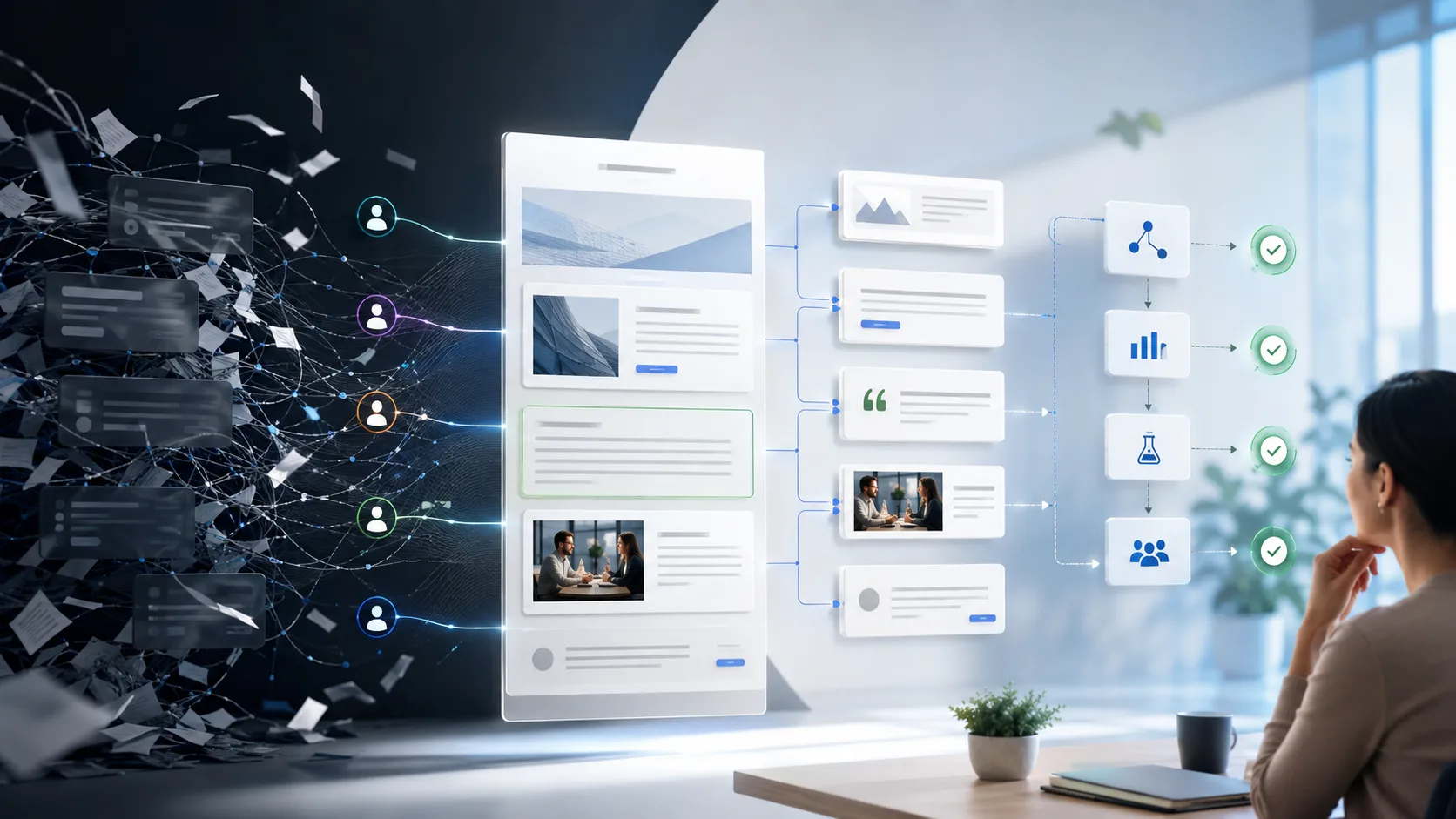
So we realized early on that the right approach wasn’t to have the LLM write everything, but to replicate aspects of the traditional marketing workflow. You break messaging into modules. Some modules — like base copy — don’t need an LLM at all. If you’re telling someone an event is happening on June 13th, that can just live in a template.
By structuring things this way, you can identify where personalization actually adds value. You bring back experimentation, drastically reduce hallucinations — in some cases almost to zero — and retain control.
When you put it all together, you end up with a very unique approach to personalization that nobody else was really thinking about. That’s a bit about how we got started. Today, I'm very optimistic about where Singulate is headed and excited about the path ahead to creating a foundationally new approach to marketing personalization in B2B.