
For a while, it looked like large language models were going to solve personalization overnight.
Give the model a prospect, a company, a role, and a goal. Ask it to write the perfect outbound email. Done.
Except, not quite.
The first wave of AI personalization produced a lot of messages that looked personalized on the surface but felt strangely generic underneath. They mentioned the right company. They referenced the right title. Sometimes they even picked up a recent funding announcement or job post. But the actual message often had the same shape: loose praise, vague relevance, and a call to action that could have been sent to almost anyone.
That is not personalization. That is mail merge with better adjectives.
The problem is not that LLMs are bad at writing. The problem is that they are too unconstrained. When every message is generated from scratch, teams lose control over positioning, proof points, claims, compliance, tone, and testing. The model becomes the strategist, copywriter, researcher, and QA process all at once. That sounds efficient until you try to scale it.
Real personalization needs structure
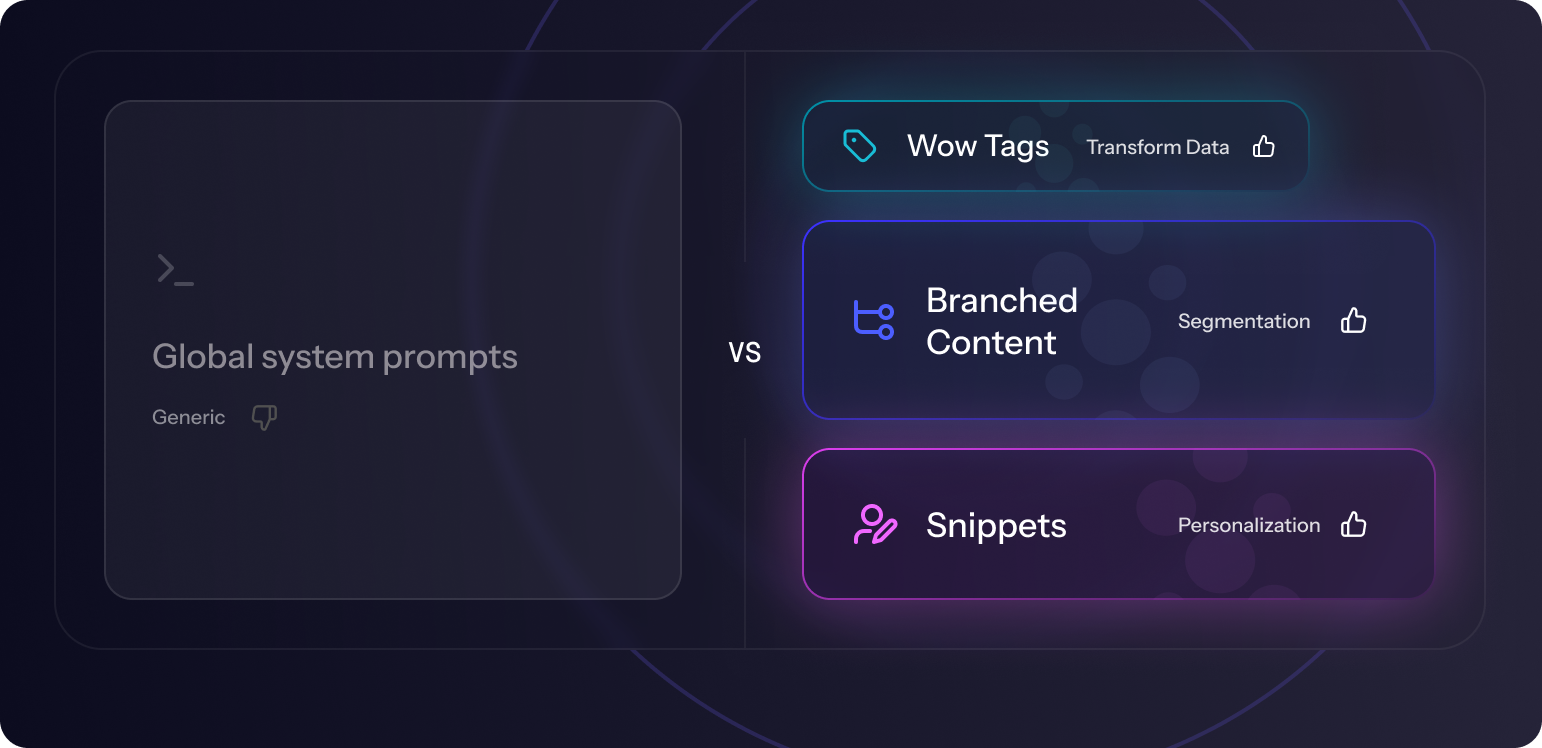
At Singulate, we think the better pattern is modular. Instead of asking AI to invent an entire message, teams should give it high-quality building blocks: approved value props, audience-specific pain points, industry context, customer proof, objection handlers, and calls to action. The AI's job is not to improvise the whole email. Its job is to assemble, adapt, and refine the right pieces for the right person.
That changes the workflow
A marketer can define the strategy once, then let AI vary the expression within clear boundaries. Sales can get messages that feel relevant without drifting away from the core narrative. Growth teams can test which components actually move outcomes instead of comparing one mysterious AI-generated paragraph against another.
This also makes personalization measurable. If a campaign performs well, you can see which message blocks contributed. If a segment underperforms, you can adjust the specific assumption, proof point, or offer instead of throwing out the whole prompt. The system becomes easier to improve because the strategy is no longer trapped inside generated prose.
The fix is better architecture
The future of AI marketing is not one giant prompt that writes everything.
It is a controlled system where humans set the strategy, AI handles the variation, and every message can be traced back to intentional choices.
LLMs did not ruin personalization because they lacked potential. They broke it because we gave them too much of the job.
The fix is not less AI. It is better architecture.
.png)