Why We Built the World’s First Messaging Personalization API
Singulate's Messaging Personalization API brings our Modular Communication Strategy Architecture to any developer, delivering higher-quality, more reliable personalized messaging at up to 90% lower token cost than traditional LLM approaches.


When John, Dave, and I started Singulate in early 2024, we shared a singular conviction: personalization was broken.
We knew that Large Language Models (LLMs) were the "missing ingredient" to fix it, but we also saw a trap that everyone else was falling into. Most companies were just throwing longer prompts at bigger models, hoping for the best. We knew that the "obvious" approach—asking an LLM to write a whole message from scratch every time—was inefficient, expensive, and frankly, not that good.
The Evolution: From MCSA to API
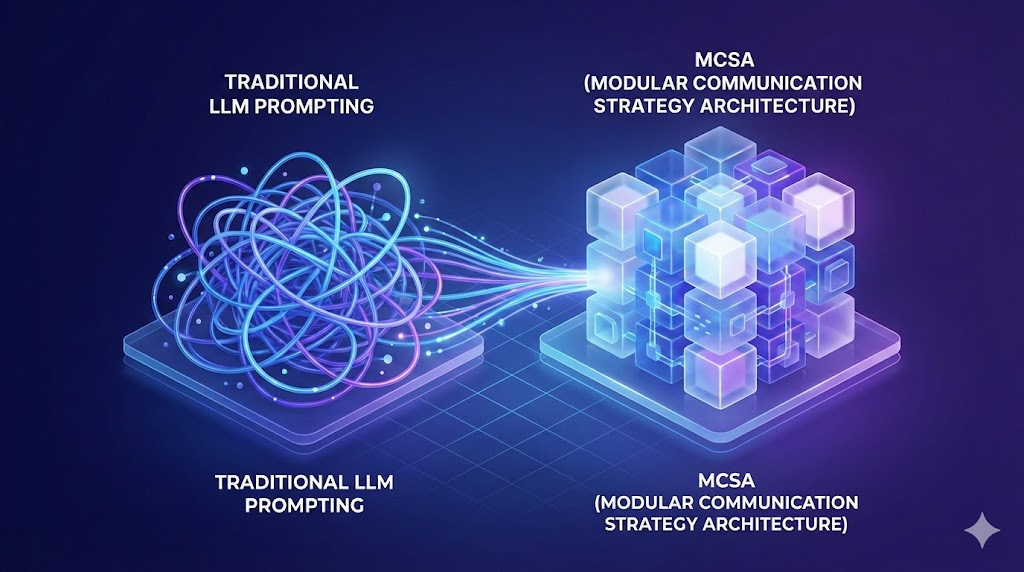
Over the course of 2024, we developed the Modular Communication Strategy Architecture (MCSA).
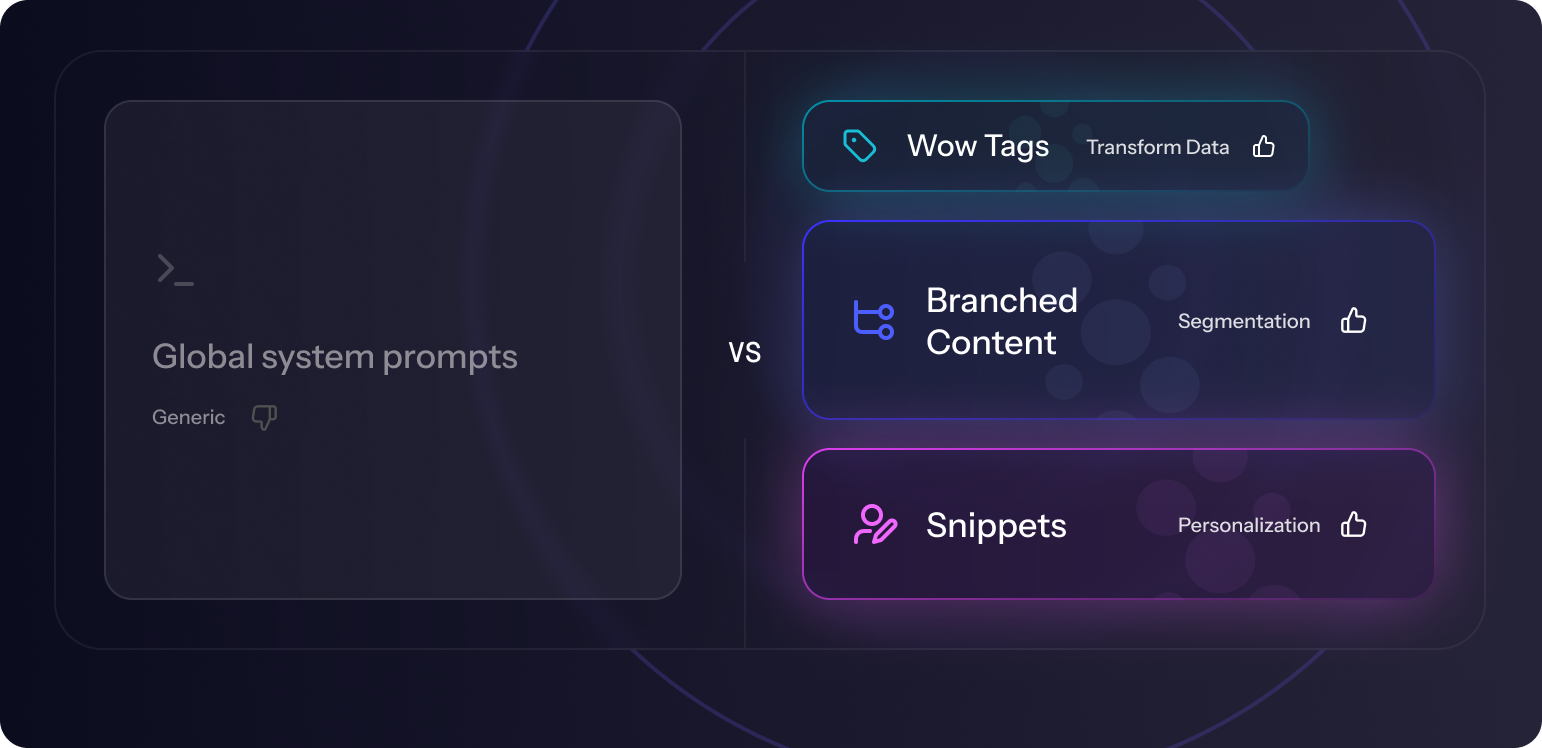
In short, MCSA is a framework that treats communication not as a single block of text, but as a structured assembly of "atomic" components. Instead of asking an AI to "write an email," we define the strategy, the audience, and the tone separately, then assemble the message based on specific logic. It moves the complexity away from the generation phase and into the structural phase.
Since then, we’ve been building the full Singulate platform—a state-of-the-art agentic editor for marketers. But we realized our tech shouldn't just live inside our own app. We wanted to distill that power into something any developer could use.
Today, I’m thrilled to introduce the world’s first Message Personalization API.
Why an API? (And why not just use GPT-5.2?)
Our personalization technology offers five distinct advantages over simply using a foundation model:
- Better Messaging: Higher quality, more human-centric output.
- Better Results: Superior performance in controlled A/B tests.
- More Reliable: Drastically reduced (or zero) hallucinations.
- Lower Message Cost: Up to 90% savings on tokens.
- Lower Research Cost: Up to 95% savings on pre-generation data processing.
The Four Pillars of Our Architecture
To achieve this, we moved away from the "one-and-done" prompt. Our API relies on four key architectural shifts:
- Modularity: Breaking messages into functional blocks.
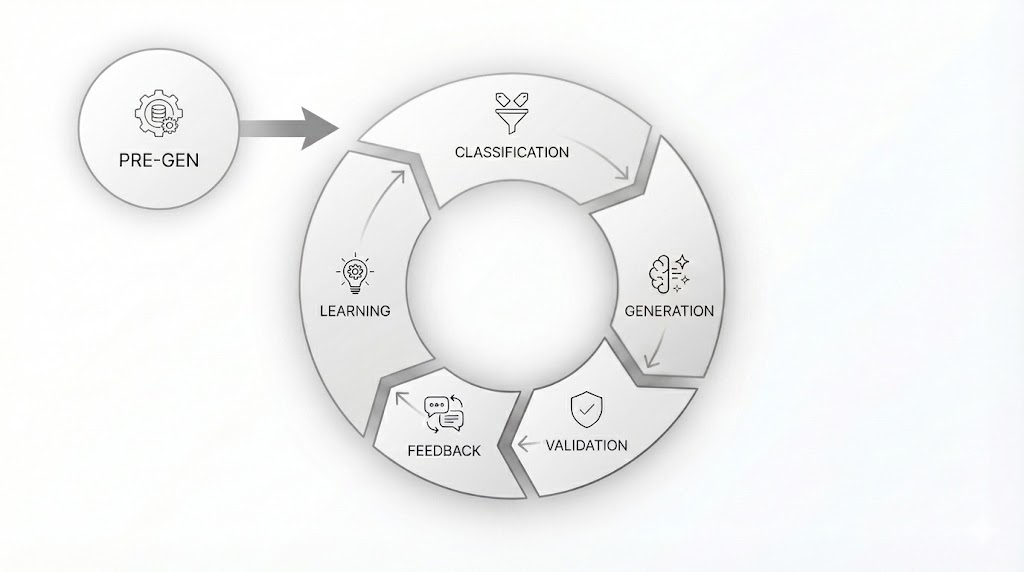
- The 4-Stage Cycle: Every message goes through Pre-generation, Classification, Generation, and Validation.
- Hybrid Intelligence: We use LLMs where they shine, but leverage deterministic code and traditional ML where they don't.
- Feedback Loops: A built-in mechanism that optimizes messaging over time based on real performance.
Getting to the Sauce: How We Did It
You might be wondering: What are the trade-offs? How can it be better AND cheaper? Let’s look under the hood.
1. Better Messaging: Solving the Complexity Paradox
There was a surprising key insight we found early on: LLMs are not consistently good at generating great messages. The more complex the personalization instructions, the worse the overall prose becomes.
We solved this by training our system on a library of world-class messaging, but more importantly, by leveraging modularity. We use our "thinking budget" to perfect the message strategy without forcing the model to rewrite the static parts of the message. This minimizes the delta between a proven, high-quality template and the personalized output. We then A/B test system prompts to reinforce the strategies that actually rank highest on quality.
2. Better Results: The Math of Modularity
In a traditional LLM powered setup, you have one prompt generating a full message. If you want to experiment, you change the prompt. But because every personalized message is unique, the variance is massive.
Modularity allows us to keep variance small. By isolating variables (like the CTA or the Hook), we can gather insights much faster. We use the standard error formula to guide our experimentation: N
Because we can control the modules that aren't subject to LLM variability, we can arrive at the optimal CTA through dynamic, controlled experiments. The result? We outperform pure LLM approaches by a significant margin because we are optimizing "where it matters most."
3. Cheaper Messages: Ending the Token Waste
Imagine an email structure:
- Hey {Name}, [Hook], We are offering a 15% discount to [Descriptor]. [CTA]. Kind regards, {Your Name}.
In a standard LLM call, the model processes your entire product catalog and customer profile just to type "Kind regards" for the 10,000th time. This is a massive waste of computation. Our studies show that changing the "outro" or the "signature" has a negligible impact on conversion.
Our solution: By fixing the non-critical parts and only personalizing the "high-impact" modules, we slash costs.
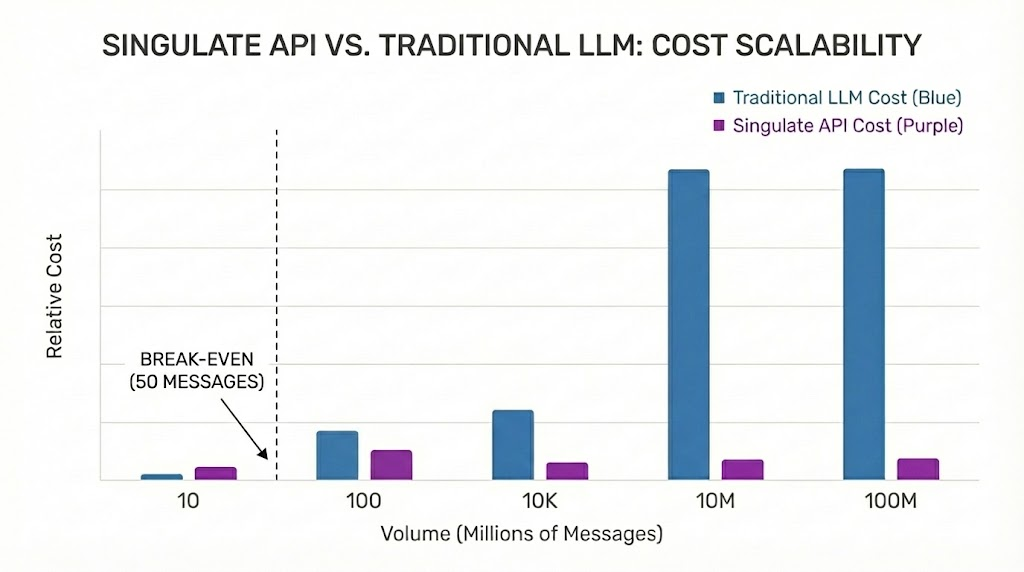
- The Trade-off: We spend a bit more at the start to generate the "Message Strategy."
- The Break-even: We’ve found the break-even point to be roughly 50 messages. If you are sending thousands or millions of messages, our approach is a total no-brainer because of the cost-savings alone.
4. Reliability: Closing the Hallucination Gap
We back our reliability with three innovations:
- Deterministic Modularity: Many modules use static transformations or decision trees. These are mathematically impossible to "hallucinate."
- Non-LLM AI: We use recommendation engines and clustering to serve templates that have already been human-verified.
- Verification Phase: Because we know exactly which modules are "dynamic," our verification step can be highly targeted. We don't have to check the whole message for errors—just the specific slice where the LLM was active.
The Future of Personalization
The results are clear: Cheaper, Better, Faster, and More Reliable. We aren't just giving you a better way to call an LLM; we are giving you an architecture for communication. Whether you are a developer building a sales tool or a growth lead at a global enterprise, the Personalization API is designed to scale your intuition without breaking your budget.
Ready to see what modular messaging can do?
Contact us at team@singulate.com for early access.