20 AI Personalization Malpractices
What B2B Marketers Need to Know About Using LLMs for Personalization at Scale in Email Marketing
.jpg)

Have you ever tried scaling personalization?
It's very technical.
Personalization at scale is like running through a minefield dodging claymores, a.k.a. obstacles like inaccurate data, AI-generated messaging, overpersonalization, and wasted time and tokens.
How did we get here?
To know this, it’s important to understand where personalization came from.
Only then can we look at how to fix it, use AI well, and scale it effectively.
A brief history of personalization
Modern personalization came to the forefront in the 1990s - the book One to One Marketing in 1993 was published right when the customer relationship management (CRMs) databases were being used with direct mail campaigns - Sears was a champion of this in the 1990s.
Then the internet and email became mainstream in the late 1990s, and personalization mimicked the same direct mail practices. Universally, personalization became known as the practice of inserting the contact’s first name into the beginning of a blast email, thus “solving” the generic email problem and making each email “unique” for each contact.
That was almost 30 years ago. Today, personalization still follows the same “mail merge” convention - commonly at the top of the WYSIWYG editor in our email software as a feature called “personalization tokens.”
Hello, AI. In 2024, everything changed.
The Large Language Models of OpenAI, Google, Anthropic, and more began rolling out their APIs, MCPs, and CLI’s for marketing engineers to activate more data into their workflows and customer engagement systems.
Instead of tokens, marketers could now use prompts, and AI could generate the full message. Thus AI SDRs and AI BDRs made their grand entrance. These automated systems generated high volumes of simple AI-generated sales emails sent to lists of target prospects.
Finally, full personalized emails were here, fully automated, booking meetings on auto-pilot. A dream come true for demand gen and growth marketers and the sales teams they served.
However, the results were disastrous.
Companies burned through their prospect lists, spamming their accounts with AI slop that yielded zero results, damaging domain reputation, and compromising their brand in the process.
The flood of AI messaging everywhere raised human awareness and detection overnight. LLM writing techniques and messaging raised flags - it quickly became the fastest way to get tuned out in email performance.
Next, in 2025, Claude Code came on the scene. Now every company could just build their own email personalization engine. Automated cold outreach was dead.
But now, in 2026, marketing teams are actively learning that personalization is not hard when it’s done by hand (or AI) manually. The difficulty of personalization only comes when it’s implemented at scale. Personalization at scale is very hard when it’s fully automated at large volumes of data.
This is why we’re still stuck with such a small view of personalization - to keep it reliable at scale; using tokens with static data is less risky and less effort to use.
But just as we no longer use CD-Roms from the 90s, we should no longer personalize emails like the 90s. There is better technology to use.
At Singulate, we’ve been studying, learning, and building solutions for personalization at scale in B2B marketing for 2.5 years.
This blog post illustrates some of the most up-to-date lessons and insights into the art and science of personalization at scale in a natively AI-powered world of email marketing, from data, to messaging, to tech, and strategy.
Two quick callouts before we dive in.
- The personalization malpractices that this article discusses mostly apply to B2B marketing emails BUT the principles can apply to both outbound, inbound and B2C use cases as well.
- Sales outreach personalization and marketing personalization are two different beasts. Personalizing a cold outreach sequence is 10x easier than personalizing a marketing email program. Sales emails are shorter, plaintext, more scripted, more constrained. Marketing emails carry branding, HTML, higher volumes, more context, and more first-party data to work with. The playbooks are different. Don't copy your SDR's personalization tactics into your MAP and expect the same results.
—————
Part 1: What Personalization Actually Is (And Isn't)
1. Personalization is not a tactic. It's a strategy.
True personalization, a.k.a. what Amazon does in your shopping app to personalize product recommendations, is extremely complex — the data layer, the messaging model, the tooling, the team — all need to work together to engineer it seamlessly for the end user. In B2B, personalization at its core is relevance architecture. It’s infrastructural, requiring product marketing, content, marketing ops, and growth all working together to execute. Personalization done right requires a top-to-bottom rethink of how you approach email marketing. Today’s marketing tools still treat it as an afterthought tactic (e.g., static tokens) for persuasion.
2. Spintax is NOT personalization. It's randomization.
Personalization has a specific definition: unique relevance to the individual. Spintax randomly rotates content to mix things up to not get caught by spam filters. It doesn't make an email more relevant to any specific person. It’s fine as a deliverability tactic, but it’s definitely not personalization because it provides no extra value to the end user. Don't confuse the two.
3. The best personalization is actually invisible.
This is the most counterintuitive thing I've learned. Good personalization doesn't feel personalized. It just feels like a good, helpful, relevant email. It's not heavy-handed, it doesn't scream "we pulled your LinkedIn," it's just content that is exactly right for that person’s use case, job to be done, interests, and journey. If someone reads your email and thinks "wow, that was personalized," you probably overdid it. They should come away from the email thinking, “wow, that was helpful” or “wow, this is interesting.” The best personalization is practically and pleasingly indetectable (like your Netflix or YouTube feed).
4. Overpersonalization is a real thing - and it backfires.
Using personal data the wrong way comes across as smarmy, overstepping, or just plain creepy. You’ve gotten these emails. It has the opposite effect on performance. Your goal with personalization is to systematize the feeling of thoughtfully professional, not overly personal. There's a big difference.
Part 2: Why Personalization Fails in Practice
The biggest objections to personalization at scale.
5. Our tools, processes, and teams are built around the email “blast.”
The "blast" email approach is so deeply embedded in marketing culture and architecture that everything in the stack is designed around it. The email is drafted in a doc, the copy is approved, the draft is loaded into the email software, the first name token is placed, and the blast is sent out. 1:1 personalization at scale is only possible if we're willing to reinvent the infrastructure around it. See the next section for what the new infrastructure looks like.
6. Messy data is a universal problem. Stop waiting to fix it perfectly.
B2B contact data decays at roughly 22.5% per year — meaning nearly one in four records in your CRM is already outdated. Stale, inaccurate data will yield bad personalization, which can have a negative impact more than just sending a generic fallback ("I don't work there anymore"). The key isn't to try to get your data to 100% perfect before you start. It's to build a system that can intelligently navigate messy data and not let it block or ruin good messaging.
7. "The juice ain't worth the squeeze."
This is the line most used to kill personalization initiatives. The argument: the operational work to get personalization right doesn't justify the results. So just blast. The problem with this logic is its protectionism. It’s the same reason why personalization strategy has remained the same in B2B marketing for almost 30 years. At Singulate, we’re reducing “the squeeze.” Meaning, we’re making it faster and easier to do sophisticated personalization strategies but at 90% less time and resources. This makes arriving at the juice much easier - that’s the real move. Reduce the squeeze so you can start experimenting with the juice until you land on your secret recipe that works reliably at scale. Drop the protectionism, try experimenting more.
8. The Merge Tag Monster still terrorizes our email marketing.
The 1980s approach to personalization still lives on today in our MAPs. You can tell tokens don't work when you put yourself in the shoes of a random contact on your list. Read your email through their eyes (Look at their actual data to understand their perspective) . Does it make sense for that specific person? Does it feel generic still? Sure, you told them their job title and company name and industry (“As a [job title] workin2g in [industry] at [company name]”... ) If not, you have more personalization work to do. This is a simple test to gut-check your personalization strategy.
Part 3: The New Paradigm AI Unlocked
9. Personalization is a two-sided challenge - data * messaging.
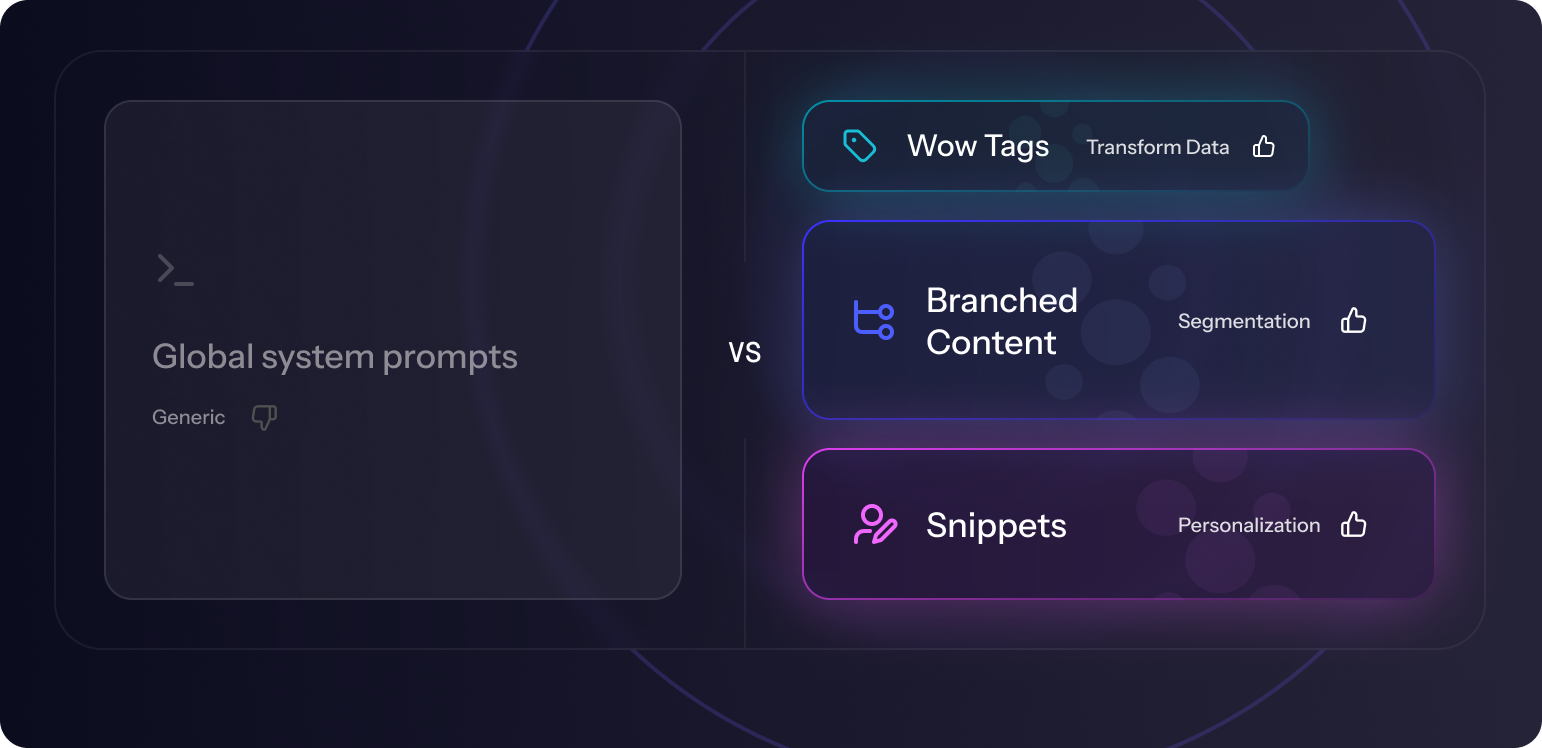
On one side: data. You need clean, fresh, structured data. On the other side: messaging. What do you say based on that data? Before AI, data was essentially the messaging — tokens and dynamic content blocks. Now, with tools like Singulate, a prompt sits between the data and the messaging. The prompt builds the messaging with the data. That's new. Data strategy is one side, messaging strategy is the other. You need both.
10. Automation and personalization are no longer antithetical.
Because of LLMs, you can now scale uniquely relevant messaging inside your marketing automation platform without the manual labor and variability risk that made it prohibitive before. Marketers using AI for email personalization have reported a 41% increase in revenue. The bottleneck isn't technology anymore. It's strategy.
11. Journey Orchestration has a messaging problem. Adaptive Messaging is the fix.
Journey orchestration is the traditional approach to automated lifecycle marketing. The problem: it limits personalized content to tokens and a handful of dynamic content blocks, which produces generic, broad emails. The new approach is adaptive messaging — where email content is adapted in real time, at the moment of send, to be most relevant to that specific contact based on their data. Together, these two approaches are what finally make 1:1 personalization at scale not just possible, but operational.
12. Examples, fine-tuning, and modular architecture are your most powerful tools.
One of the most effective ways to get consistent, reliable output from an LLM is to train it on what good looks like. The more high-quality examples you feed the model, the less variability you get at scale. Don't skip this step. Next, check contact-level outputs and weigh them against their data profile (use the Shoe Test). Is this email good for Jamie? For Craig? For Sam? Continue fine-tuning your prompt until it works for everyone on the list. At Singulate, we recommend an approval streak of 10 contacts to “set” the pattern of personalization so that it reliably scales.
13. Work backwards from the output to control variability.
Here's a tactical move most people miss. Instead of saying "write a personalized CTA that mentions job title," say: "Write exactly this: 'We're offering growth marketers at health tech companies a special end-of-month discount. Are you available next week?' —but then replace the parts of that message with each contact's corresponding data to personalize it." Massage the prompt so that the data and messaging weave together smoothly and naturally. With fine-tuning, you’ll get something reliable and adaptable. Begin with a solid structure - this will help reduce LLM variability and tone, and provide you with a constrained, scalable personalization strategy.
Part 4: How to Actually Execute
14. Put 40% of your personalization effort on the first line. Specifically, the first five words. That preview text is visible next to the subject line in the inbox and can drive a 10–15% lift in open rates by itself. If you're going to personalize anything, start here. The inbox preview is the highest-leverage real estate in the entire email.
15. The 2nd best-leverage real estate in an email is the PS. After the subject line + hook, personalizing the PS with a segmented low-friction secondary CTA can increase your CTR by 50% or more.
16. Not every email needs personalization. Not every module does either. Here's the filter: if you had all the time in the world to review every contact's data and write each one an email by hand, would your emails look different across the list? How different? If the answer is "not that different," there’s not much to personalize with (consider running data enrichment on the list). However, if each email would be genuinely unique in order to be relevant, build a personalization strategy around it.
17. Personalization is not a silver bullet. It rarely works right away. Rather, it’s a system that requires testing and iteration over time.
Personalization won't save a bad email. It won't fix a broken list or poor sender reputation. But once the right data and messaging strategy are dialed in, it has the potential to lift engagement 2–7x and beyond. The difference between campaigns that convert and campaigns that don't is almost always relevance - and the data and messaging strategy chosen to achieve it.
18. Deliverability and personalization are the same bet.
Deliverability is on the technical side, to ensure the email reaches the inbox. Personalization is on the human side, to ensure that the email is relevant and engages with the user. Spam filters exist to protect inboxes from irrelevant email. 1 in 6 marketing emails never reaches the inbox — and the primary reason is irrelevance. Personalization is exactly the mechanism that makes an email worth receiving. These two things go hand-in-glove.
19. What use cases should you be thinking about personalization at scale for? The highest-ROI use cases for personalization in B2B right now:
- Event and webinar invites — personalize what's relevant based on role, seniority, industry, company size, and location - and why this specific person should be there. Lifts registrations by 20-60%.
- Event follow-ups — personalize the takeaways based on persona. Books 40% more demos.
- Product onboarding journeys — personalize the use case and next best step for each user based on their industry and product usage data. Drives 24-36% higher activation rate.
- Newsletters and feature releases — personalize the updates for relevance to their specific sub-industry and ICP; tailor the feature release to their specific use case for your product and the painpoint they’re trying to solve.
Closing: Where This Is All Going
We’re only at the beginning stages. I think we’re 3-5 years away from the nextgen MAPs (like Singulate) being fully built-out to replace the legacy platforms that were built pre-AI. The future looks like always-on agentic research, recommendations, and review systems. A marketer will input a campaign strategy brief and the system will take it from there to distribute the most relevant composition of the marketer’s campaign to every contact on the list. The marketer will guide and approve throughout the process but 90% of the data, ops, and content operations will be handled autonomously.
20. AI summaries in the inbox: If your marketing email isn't recapped, it will be decapped.
AI summaries are now live across Apple Mail, Gmail, Yahoo, and Microsoft Outlook. Apple Intelligence has replaced sender-authored preview text with AI-generated summaries on the world's largest email client — at roughly 51% open share. Gmail's Gemini inbox is surfacing prioritized highlights, not chronological messages. An AI intermediary now sits between your email and your subscriber's attention. If you don’t connect the dots for how your email is relevant to each user, it won’t make it.
What gets surfaced? Relevant content. What gets filtered? Everything else.
21. Bonus: Email is not dead. Spam is (Agents will kill it)
Unwanted blast emails will never make it past Guardian Agents. Sure, companies can keep sending irrelevant emails, but they’re wasting their time. Every email will be tailored to the end user and inbox agents will be looking for that signal. If you don’t do the work of making it front and center, your email will be sequestered away or simply overlooked.
People’s preferences change. Data will inevitably change. People will unsubscribe - and that’s okay. It’s better to be seen and acted upon, then unseen and ignored.
In the end, personalization, like people, is ever-evolving, but traditional tactics haven’t adapted to the new technology available to us - let’s leave the old strategies forced by old technology and embrace an exciting new world of personalization at scale in B2B marketing.
Ladies and gentlemen, start your personalization engines, the next email race is about to begin.